
Privately Owned Insurance Companies (POIC): A Business Owner's Guide
A Privately Owned Insurance Company (POIC) is a legal, IRS-compliant insurance company you own that insures your business’s own uninsured and under-insured risks. Instead of paying premiums to an outside carrier and never seeing that money again, you keep the underwriting profit — net of any claims — inside a company you control.
For middle-market business owners, a privately owned insurance company turns a recurring cost into a long-term asset. This guide explains what a POIC is, how it works, what it covers, how it compares to a captive, and how Reinsurance Specialties implements it through The Latitude Plan.
Private insurance for the middle market
For decades, large corporations have used private insurance and alternative risk transfer to manage risk, reduce insurance costs, and capture underwriting profit — and the capital behind that market is at an all-time high, with global reinsurer capital reaching a record $785 billion at the end of 2025 (Aon). Today that same strategy is available to middle-market companies. Reinsurance Specialties serves business leaders nationwide — with clients in 30 U.S. states and growing — across virtually every industry.
What is a privately owned insurance company (POIC)?
A privately owned insurance company (POIC) is a closely held insurance company formed primarily to insure the uninsured and under-insured risks of its owner and affiliated businesses. As the owner, you are involved in the operations that matter: underwriting, policy placement, claims decisions, investments, and annual strategy.
A POIC re-insures risks that your standard commercial policies leave exposed. It doesn’t replace your commercial property and casualty coverage — it sits on top of it, covering the gaps that traditional carriers avoid or overprice.
How did private insurance become available to the middle market?
Private insurance isn’t new. Self-insurance dates back to the 1600s; the modern reinsurance platforms that anchor today’s market formed in Bermuda in the 1960s and were formalized in the late 1970s — including an early structure built around Harvard University’s medical malpractice exposure. Federal risk-retention legislation followed in 1986.
What changed for smaller companies was access, not the concept. Until 2001, IRS regulations effectively kept these structures out of reach for middle-market businesses. A series of IRS “safe harbor” rulings in 2001, 2002, and 2005 established the framework that made compliant private insurance practical for privately held companies.
Why business owners form a privately owned insurance company through The Latitude Plan.
Forming a privately owned insurance company through The Latitude Plan lets a business retain underwriting profits, gain control over claims, and tailor coverage for risks that are otherwise hard to place. It supports tax-efficient reserve planning, improved cash flow, and investment strategies aligned with growth and M&A — converting insurance premiums into company-controlled assets.
Financial advantages
Retain underwriting profits and investment income, access potential tax benefits, and lower administrative costs compared with conventional commercial insurance.
Strategic flexibility
Retain underwriting profit while gaining the flexibility to cover risks that traditional carriers routinely decline or overprice.
Operational control
Direct control over claims management and risk management, plus the ability to customize policy language for niche or hard-to-place risks.
Long-term value
Build equity through an insurance vehicle that can serve as a profit center, separate from your operating businesses.
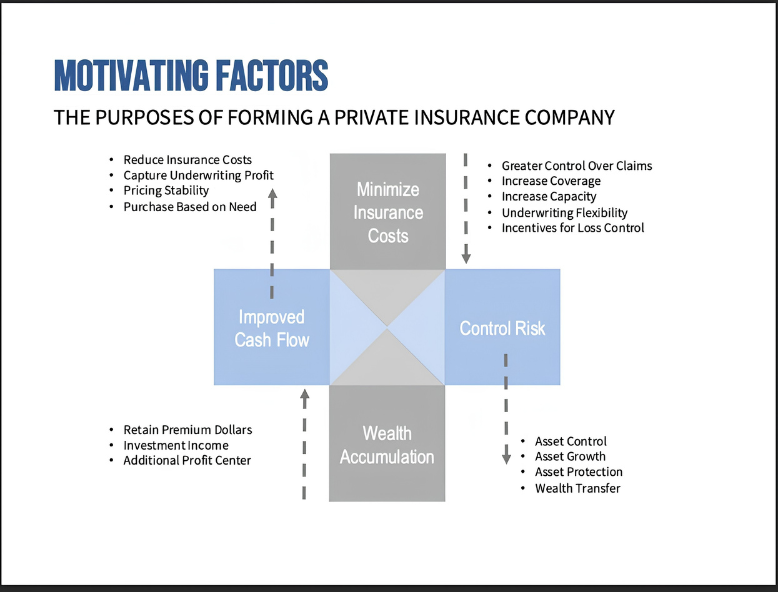
How business owners use a privately owned insurance company through The Latitude Plan
Business leaders across every industry use private insurance to mitigate risk, control claims, improve cash flow, protect assets, and build long-term, transferable wealth — all within a compliant insurance framework. Here are common, solutions-based applications:
Specialized coverage
Hard-to-place coverage such as business interruption or Directors & Officers can be obtained at reasonable, consistent rates.
Creditors & finance
Financial organizations can use The Latitude Plan to underwrite credit-related exposures, including collateral protection vendor single-interest and other creditor risks, while retaining premium and profit that would otherwise flow to a commercial carrier.
Construction
The Latitude Plan can re-insure subcontractor default, construction defects, mold, and other construction-related general liability, improving the cash flow and profitability of the general contractor or developer.
Medical malpractice
Hospitals, physician groups, and medical professionals can self-insure all or part of malpractice risk, capturing underwriting profit and achieving better loss and claims control.
Property coverage
For organizations with significant property exposure, The Latitude Plan can absorb retained layers or re-insure portions of existing coverage — creating a more efficient risk financing structure and lowering total insurance spend.
Non-traditional lines
The Latitude Plan can re-insure coverages like cyber liability, political risk/trade disruption, supply chain disruption, key person/key employee, performance guarantees, construction defect and extended warranty programs.
What's the difference between a privately owned insurance company, a captive, and an 831(b) micro-captive?
These terms overlap, which causes confusion. Here’s the plain-language version:
Captive insurance is the broad category: an insurance company owned by the business it insures. The term dates to 1955. A POIC is a modern form of captive.
An 831(b) micro-captive is a specific tax election that the IRS has scrutinized heavily for abusive tax sheltering. Poorly designed or ill-intended micro-captives have drawn audits and penalties.
The Latitude Plan is a privately owned insurance company structured under an 831(a) designation — not an 831(b) micro-captive. It uses a simple, linear transfer of risk by policy and treaty, files annual federal tax returns, and deliberately excludes the elements associated with IRS scrutiny: no 831(b) election, no offshore accounts, no risk pooling, and no trust agreements.

The Latitude Plan — our POIC structure
By now you can see the flexibility of a privately owned insurance company. The Latitude Plan is how Reinsurance Specialties puts it to work — a POIC structure refined over nearly three decades. Two things set it apart from conventional captive and private-insurance models:
Sovereign tribal domicile. Your privately owned insurance company is formed through The Latitude Plan under the legal jurisdiction of a federally recognized Native American tribe, supported by the Indian Reorganization Act of 1934 — not a U.S. state or an offshore territory.
An 831(a) designation, not a scrutinized micro-captive. The Latitude Plan operates under an 831(a) designation and files annual federal tax returns. It is deliberately designed to exclude the elements that draw IRS scrutiny — no 831(b) micro-captive election, no offshore accounts, no risk pooling, no trust agreements, and no outside administrators.
What business leaders say
"We vetted many servicing companies before landing on this reinsurance platform. They have been extremely helpful in introduction, education, and connections with third-party operational teams."
Jeff M., Florida
"Reinsurance is a beautiful business tool used to help control business risk exposures surrounding our ten LLCs; we remit tax-advantaged premium monthly and enjoy mitigating our collective risks."
Morgan J., New York
"Reinsurance Specialties has surrounded itself with subject-matter experts who bring education, actuarial assessment samples, case studies, and insights to the table. The onboarding with the third-party insurer was simple and straightforward."
Rick W., Florida
Schedule a Call
You’ll be meeting with the team behind The Latitude Plan.